

Lifting a large dog incorrectly is one of the most common causes of stress and injury for both arthritic senior dogs and their owners. The dog panics because her arthritic joints are grabbed awkwardly. The owner strains their back lifting from a poor position. Neither needs to happen. Here is exactly how to do it right.
Before You Lift: Key Principles
The Correct Lifting Technique: Step by Step
For a dog between 15 and 30kg, this two-arm technique keeps the spine level and gives you control of both ends.
- Approach calmly and let her smell your hands. A dog who sees a lift coming and tenses up is harder to hold and more likely to be injured. Talk to her, let her settle, then position yourself.
- Squat on her side, one knee on the ground. Get as low as she is so you are lifting up, not bending over and pulling.
- Place one arm under her chest, behind the front legs. Your forearm runs parallel to her body. Her chest rests across your forearm.
- Place your other arm under her hindquarters. Behind the hind legs, supporting her pelvis. Both arms are now under her at the same height.
- Bring her body against your chest before rising. Hold her close to your torso, not at arm’s length. This distributes her weight through your body, not your shoulder joints.
- Rise using your legs. Push through your feet. Keep your back straight. Straighten slowly.
- Keep her level throughout. Neither end should drop lower than the other at any point in the lift.
The moment most dogs become distressed during lifting is when the back end drops. The front is held securely but the hindquarters suddenly feel unsupported. For an arthritic dog this is both frightening and painful. Your second arm under the pelvis is the most important part of the lift. Place it before you attempt to rise.
Lifting a Large Dog Into the Car
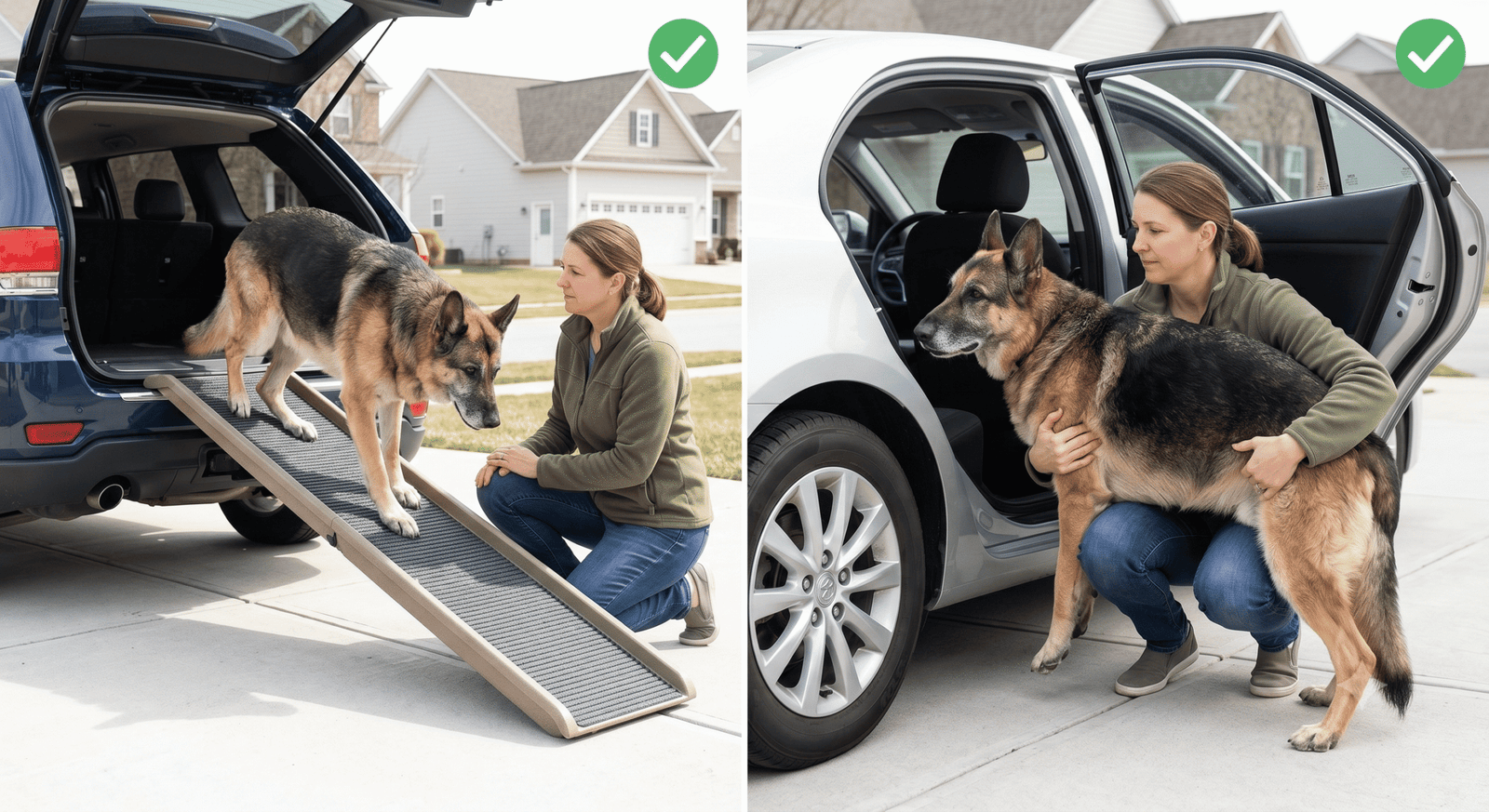
Car entry is one of the most common lifting situations. The height difference between the ground and the car floor, combined with the need to move forward, makes this awkward for both dog and owner.
Position the dog parallel to the car, hind end closest to the opening. Use the standard two-arm lift technique to get her up to door level, then slide her in rather than lifting to full car height and then placing her forward. The slide reduces the height you need to lift to.
Helping a Dog Up From the Floor
A dog who has gone down and cannot get back up without help needs assistance at the hip and chest simultaneously, not a pull from the collar.
Position yourself beside her. Place one hand flat under the chest for support and the other hand flat under the pelvis. Do not grip or squeeze. Apply gentle upward pressure to both points at the same time as she tries to push up with her own legs. You are assisting, not replacing her effort.
If she cannot rise at all even with assistance, this is an emergency vet situation, not a lifting problem.
Tools That Make Lifting Easier and Safer
Rear Support Harness
A harness with a handle over the hind end. Allows you to support and partially lift the back end while the dog uses her front legs. Excellent for dogs who can walk but need help with stairs and getting up.
Car Ramp
Removes the need to lift for car entry entirely. Most large senior dogs with arthritis can use a gently inclined ramp with some encouragement and practice.
Lift Sling
A fabric sling that passes under the dog’s abdomen and hind end. Provides handles for a two-person lift or to give one person better leverage. Used in veterinary practices for a reason.
Raised Dog Bed
A bed at a height the dog can step onto rather than lowering herself to the floor reduces the number of times a painful lift is needed during the day.
What Never to Do When Lifting
A dog who growls or snaps during lifting is communicating pain. The lift is touching or moving something that hurts. This is not aggression, it is a pain response. Contact your vet about pain assessment before attempting further lifts. Using a sling rather than direct contact may reduce the pain trigger. Never punish a dog for growling during a painful experience, as it removes the warning signal without removing the pain.
Encourage self-movement as much as possible. Muscle strength supports joints. A dog who stops using her muscles because she is always carried loses the muscle support that protects her arthritic joints. Help her when she genuinely cannot manage, assist her when she struggles, but let her try first. Non-slip flooring throughout the house often allows dogs who appeared unable to get up to manage independently on grippy surfaces.
The Bottom Line
Lifting a large senior dog safely takes 30 seconds of preparation and two simple rules: support both ends simultaneously, and lift using your legs not your back.
For dogs over 25 kilograms, invest in a rear support harness or lift sling. For car entry, a ramp eliminates the problem entirely. Small tools make a significant difference to how manageable daily care is for both you and your dog over months and years of supporting her mobility.